


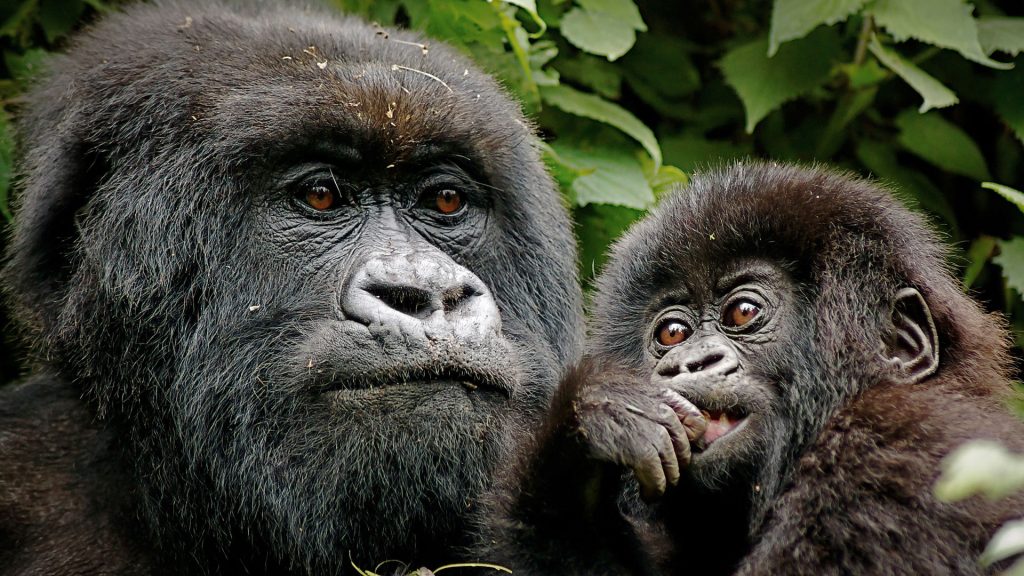
Life Behind the Gorillas Discovering How Gorillas Live in the Forest

When you set foot into the forest world of gorillas, you’re entering a realm of dense vegetation, ancient trees, and incredibly complex social lives. In this article we’ll explore how gorillas live in the forest—from their habitat and home range, to diet, social structure, daily routines, adaptations, and threats. This is especially useful if you’re writing travel or wildlife-tourism content focused on places like Uganda and East/Central Africa.
We will use high-ranking and search-friendly keywords such as “gorilla forest habitat”, “mountain gorilla lifestyle”, “western lowland gorilla diet”, “gorilla social structure in forest”, “gorilla adaptation to forest life”, and “gorillas in Uganda forest” to ensure SEO resonance.
1.Forest Habitat: Where Gorillas Call Home
Gorillas inhabit tropical forest ecosystems that vary from lowland rainforests to high-altitude montane forests.
The two main species (the eastern gorilla and the western gorilla) are distributed across equatorial Africa, and their subspecies are adapted to different forest zones.
For example, the Mountain Gorilla (a subspecies of eastern) lives in montane forest and sub-alpine forest, such as the steep slopes of the Bwindi Impenetrable Forest in Uganda and the Virunga mountains region.
The Western Lowland Gorilla lives in lowland rainforest, swamp forest, forest edges and secondary vegetation in Central/Western Africa.
Their home-range size varies widely: from a few square kilometers up to 30 km² or more, depending on food availability and forest condition.
Key takeaway: A healthy forest habitat with dense vegetation, fruit- and foliage-rich zones, safe nesting sites and minimal human disturbance is critical for gorilla life. For travel/marketing copy, emphasize “pristine forest habitat”, “lush forest canopy”, “ancient rainforest home of gorillas”.
2. Daily Life & Movement in the Forest
Life in the forest for gorillas involves daily movement, foraging for food, resting/nesting, and social interaction.
Foraging & movement
Gorillas spend a large part of their day feeding on vegetation: leaves, stems, shoots, bamboo, bark, fruit and sometimes invertebrates.
For example, mountain gorillas may eat up to 34 kg of vegetation a day for an adult male and about 18 kg for a female.
They move through their home-ranges searching for food. Because the forest terrain is uneven and sometimes steep (especially in montane zones), their limbs and body are adapted for that.
They also build new nests each evening: either on the ground or in low trees/branches, depending on the subspecies and forest type.
Resting & nesting
At dusk (or before), gorillas construct a nest: typically bending branches, leaves and twigs. They may nest on the ground or in trees (ground more common).
Each nest is generally used for one night and then abandoned. This helps avoid parasites, ensures fresh sites, and reflects movement in the forest.
Key takeaway for content: Emphasize “foraging through ancient rainforest”, “wide ranging forest movement”, “evening nests under the forest canopy”, “great ape daily rhythm in the wild”.
3. Social Structure & Family Life in the Forest
Social life is central to how gorillas live in forests. Their group dynamics, leadership, and interactions are fascinating and important for storytelling.
Troops / groups
A typical gorilla family group (often called a “troop” or “group”) is led by a dominant adult male called the silverback.
Group size can vary: usually 5-10 members, but some groups may exceed 20 or more depending on the habitat and resources.
Females typically become sexually mature around 7-8 years old, but they may not breed immediately. Males mature later (often around age 15) in many cases.
Role of the silverback
The silverback makes key decisions: where to move, when to feed, where to rest, and protects the troop from threats.
When threatened, the silverback can perform loud displays: chest-beating, hooting, charges, tearing vegetation to intimidate rivals or intruders.
Despite their great strength, gorillas are generally gentle and shy, and aggression is rare when groups are stable and undisturbed.
Mothers, infants & juveniles
Gorilla mothers give birth after a gestation of about 8.5 months and usually raise one infant at a time. Infant mortality is high.
Young gorillas learn by playing, climbing, exploring the forest environment. Their social interactions in the forest help them build skills.
Forest structure (trees, vines, vegetation) provides the playground for juvenile gorillas.
Key takeaway for content: Use phrases like “close-knit gorilla family in the rainforest”, “silverback leading his troop through forest trails”, “infant gorilla cradled under fern canopy”, “forest as a classroom for young gorillas”.
4. Adaptations to Forest Life
Living in the forest demands special evolutionary adaptations. Gorillas display many traits suited to forest terrain, diet, climate and social life.
Physical adaptations
Gorillas walk on their knuckles (“knuckle-walking”), which supports locomotion in dense forest undergrowth and uneven terrain.
Their arms are often longer than the legs, which aids in reaching vegetation and moving through forest understory.
In the higher altitudes of montane forests (where mountain gorillas live) they have thicker fur for insulation against colder temperatures, mist, and damp conditions.
Behavioral adaptations
Nest-making each night is an adaptation to forest life: safe resting spots within the forest, on the ground or in low trees depending on subspecies.
Social structure and group life provide protection in forest settings, as well as collaboration in location of food, navigating terrain, and predator/competitor defense.
Communication via vocalizations, body language, and gestures are essential when in dense forest where visibility is limited.
Key takeaway for content: Highlight “designed for rainforest life”, “built for steep forest slopes and bamboo zones”, “everyday forest adaptation in gorilla communities”.
5. Diet: A Forest Feast
The diet of gorillas is intimately tied to the forest plant life. Understanding what they eat and how that depends on forest type adds depth to the story.
Gorillas are primarily herbivores (vegetarian). Their diet consists largely of leaves, stems, shoots, bamboo, bark, and fruit where available.
For example, the mountain gorilla diet comprises ~85.8% leaves, shoots and stems from many plant species; bark, roots, flowers and occasionally invertebrates make up the rest.
In lowland forests, food variety may include more fruit, but in high-altitude montane forests fruit may be scarce so foliage becomes more dominant.
Because vegetation is bulky and lower in caloric density than meat, gorillas can spend large parts of the day feeding. The forest needs to supply enough vegetation in the home-range.
Key takeaway for content: Use phrases like “forest herbivore of the African jungles”, “foraging through emerald rainforest vegetation”, “feeding in the misty bamboo zones”, “leaves, shoots and vines: the gorilla buffet in the wild”.
6. Movement, Territory & Home-Range in the Forest
Gorillas don’t stay in one place forever—they move through their forest habitat in search of food, rest sites and safety.
Home-range size, movement distances and daily travel depend on habitat type, food availability, and terrain. For example, in richer habitats, ranges may be smaller; in poor habitats, groups must travel further.
The home-range may overlap with those of other groups; gorillas are not strictly territorial in the sense of excluding neighbors entirely.
Terrain matters: montane forest means steep slopes, mist, low visibility; lowland rainforest means dense undergrowth, swamp or riverine zones. These affect movement speed, rest times, and energy expenditure.
Within the forest, the search for food, safe nesting sites and avoidance of humans/poachers shapes their movement and behavior.
Key takeaway for content: Include terms like “forest home-range”, “jungle trails followed by gorilla family”, “mountain forest movement”, “forest terrain shaping gorilla life”.
7. Forest Environment & Its Impact on Gorilla Life
The forest is not just the backdrop — it is the gorilla’s world, and its features dramatically shape their lives.
Forest stratification & vegetation zones
In mountain forests (for mountain gorillas), there are multiple vegetation zones: e.g., bamboo forests (2,200-2,800 m), Hagenah forest (2,800-3,400 m), giant senecio zone (3,400-4,300 m).
Such zones provide different food types, different climate/temperature, and different nesting/resting challenges.
In lowland rainforest zones, elevation is lower; vegetation can include swamp forest, secondary forest, forest edges and deep primary rainforest.
Climatic & terrain influences
Montane forests tend to be colder, mistier, with a thick canopy and steep slopes. This demands adaptations (thick fur, strong limbs).
Lowland forests may be warmer, more humid, with thicker undergrowth, and more diverse fruit resources.
The forest’s health, vegetation density, fruiting seasons, presence of water, and human encroachment all impact gorilla survival and behavior.
Key takeaway for content: Use scenic phrases such as “mist-shrouded mountain forest”, “ancient rainforests of Central Africa”, “emerald canopy and vine-laden forest”, “jungle home of the great apes”.
8. Threats to Forest-Living Gorillas
No story of gorilla forest life is complete without acknowledging the threats to their habitat and survival. This is especially relevant for tourism, conservation-aware content, and SEO keywords like “gorilla habitat loss”, “threats to mountain gorilla in forest”, “deforestation gorilla forest”.
The destruction and fragmentation of gorilla forest habitat is a major threat: agriculture, logging, human settlements, road building all degrade forest.
Diseases (especially in forest-habitat contexts where gorillas and humans come into contact) pose risks to gorilla populations.
Low reproductive rate and slow life-history (few offspring, long maturation) mean that gorilla populations cannot easily recover from heavy losses.
Climate change and changes in forest ecology (e.g., fruiting patterns, vegetation shifts) may also affect gorillas in forest habitats.
Key takeaway for content: When writing, mention “conserving forest habitats”, “protecting gorilla forest homes”, “forest protection supports gorilla survival”. This bridges tourism, eco-travel, and conservation SEO angles.
9. Gorilla Life in Uganda’s Forests — A Case Study
Since your interest includes Uganda, let’s briefly focus on how gorillas live in Uganda’s forest habitats. This will serve well in SEO for “gorillas in Uganda forest” or “Uganda mountain gorilla forest life”.
In Uganda, mountain gorillas are found in places like Bwindi Impenetrable Forest and Mgahinga Gorilla National Park.
These forests are steep, misty, and ancient rain-forest zones—perfect for telling a narrative of “jungle adventure”.
For example: “Gorilla tracking through the lush undergrowth of Bwindi, where dense forest canopy, fresh jungle air and the rhythm of gorilla family movement combine to tell a story of life behind the gorillas.”
You might highlight how mountain gorillas build nests each night in the forest, move across vegetation zones, and feed on leaves, shoots and bamboo in the forest environment.
Key takeaway for content: When referencing Uganda, pair keywords like “Uganda gorilla forest experience”, “forest habitat of mountain gorillas Uganda”, and “jungle life of gorillas Uganda”.
10. Bringing It All Together — Storytelling & SEO Tips
To craft effective SEO-optimized content around “life behind gorillas” in the forest, here are some tips:
Use long-tail keywords: e.g. “how gorillas live in the forest”, “forest habitat of gorillas in Africa”, “daily life of mountain gorillas in Uganda forest”, “gorilla family in rainforest environment”.
Structure your article: Use subheadings (as above) that incorporate keywords like “forest habitat”, “diet and foraging forest”, “social structure in forest”, “adaptations to forest life”.
Include local context: Since Uganda is your focus, mention specific forests (Bwindi, Mgahinga), mountain gorillas, rainforest zones.
Engage the reader: Describe what a day in the forest might look like for a gorilla – waking up in the jungle, foraging under the forest canopy, nesting in a fresh bed of branches, interacting with the troop.
Use sensory language: “Jungle trails winding beneath ancient trees”, “misty forest slopes”, “rustle of leaves as gorillas move”, “emerald sea of rainforest vegetation”. This helps retain readers and reduce bounce rate—which helps SEO.
Link to conservation and travel: A section about threats ties into keywords like “gorilla conservation in forest”, “forest habitat loss affecting gorillas”. And for tourism, “experience gorilla forest trekking” is a strong keyword.
Include internal and external links: Link to relevant pages about Uganda tourism, gorilla trekking permits, forest ecology. Use authoritative external sources (such as WWF, National Geographic) for credibility.
Conclusion
The forest is far more than a backdrop for gorillas — it defines how they live, move, feed, nest, socialize, and survive. Understanding the forest habitat, the daily routines of foraging and resting, the group dynamics under the leadership of the silverback, and the adaptations that gorillas bring to life in dense jungle terrain gives us a richer appreciation of “life behind gorillas”.
For your content, especially if it’s oriented toward travel, tourism, or wildlife-education in Uganda, weaving together the ecological facts with evocative forest imagery and user-friendly SEO keywords will make your piece both compelling and search-engine friendly.
By .HADIJJA DUDU FROM VICTORIA UNIVERSITY


